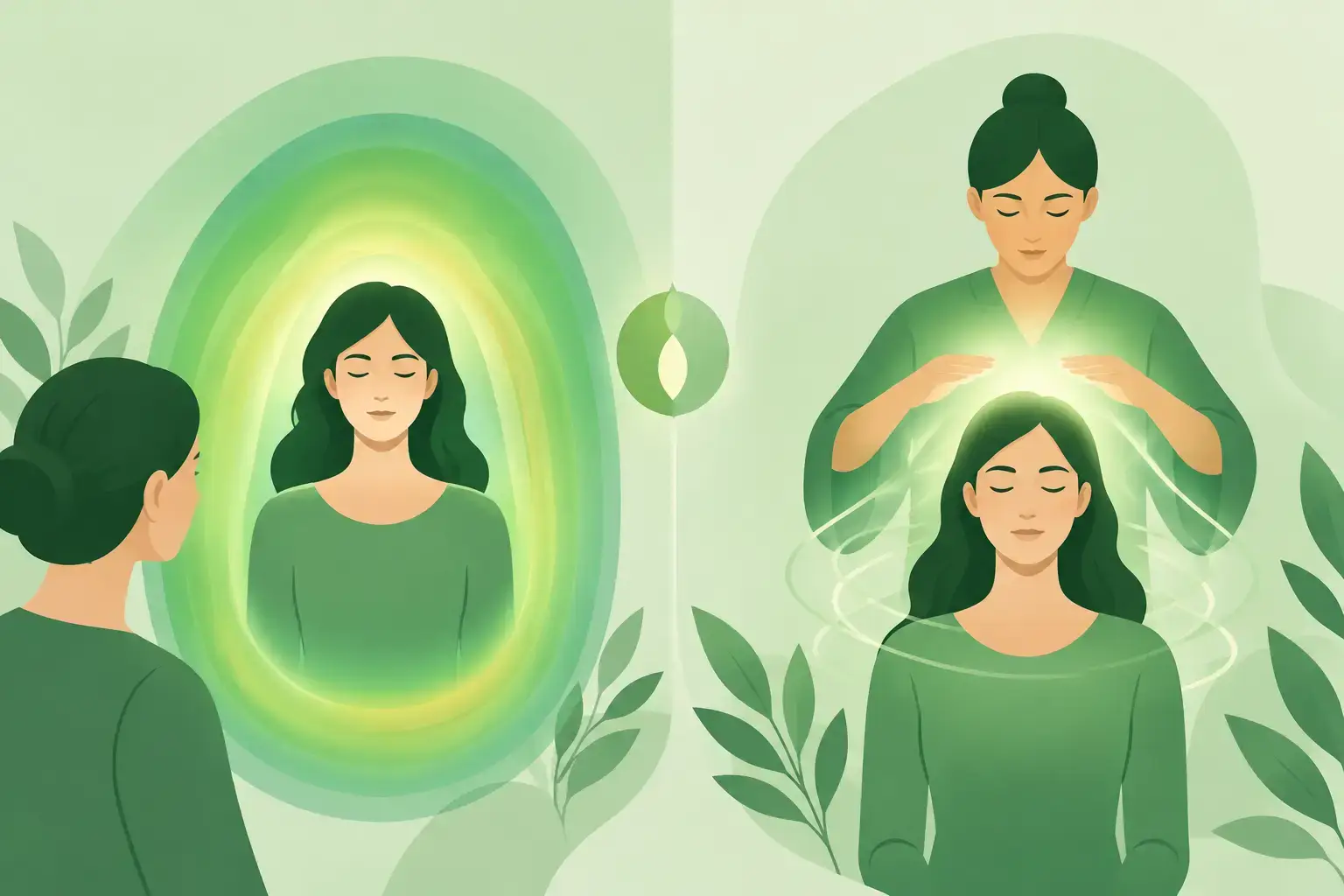
Someone may leave an aura reading feeling deeply seen, while someone else leaves an energy healing session feeling calmer, lighter, or more settled in their body. Both experiences can be meaningful, but aura reading vs energy healing is not an either-or question. These practices serve different purposes, use different skills, and can support different points in your spiritual growth.
The confusion is understandable. Both work with subtle energy. Both may involve intuition, chakras, colors, emotions, and spiritual insight. Yet one is primarily about perceiving and interpreting energy, while the other is about supporting energetic balance and release. Knowing the difference helps you choose the right kind of support and develop your own abilities with clarity and confidence.
What Is an Aura Reading?
An aura reading is the practice of sensing, seeing, or intuitively interpreting the energetic field around a person. In many spiritual traditions, the aura is understood as a field that reflects aspects of a person’s emotional state, mental patterns, spiritual development, and current energy.
A reader may receive information in different ways. They may notice colors, images, physical sensations, words, symbols, shifts in temperature, or an immediate inner knowing. A yellow quality around someone, for example, might be interpreted as mental activity, confidence, or a need to reconnect with personal joy. A dense sensation around the chest may point toward grief, guardedness, or an emotion asking to be acknowledged.
The key word is interpretation. An aura is not a fixed label, and a responsible reading is not a diagnosis or a prediction carved in stone. Energy can shift with stress, rest, relationships, boundaries, health, and personal choices. A good reader communicates what they perceive without making dramatic claims or taking away the client’s agency.
What an aura reading can offer
An aura reading can bring language to what a person has been sensing but has not been able to name. It can highlight recurring emotional patterns, areas of energetic strength, places where someone may be overextending themselves, or themes that are ready for attention.
For beginners, learning aura reading can also strengthen intuitive discernment. Instead of relying on scattered meanings from social media, structured training teaches you how to ground yourself, observe without jumping to conclusions, and communicate insights in an ethical, useful way.
What Is Energy Healing?
Energy healing is a broad term for practices intended to support balance in the body’s subtle energy system. Depending on the method, a practitioner may work with hands-on or hands-off techniques, intention, visualization, breath, chakra balancing, sound, prayer, or other focused practices.
The purpose is not primarily to interpret what the energy means. It is to create conditions that may help a person feel more centered, relaxed, clear, or connected to themselves. Some people seek energy healing after a stressful period, during emotional transitions, or when they feel spiritually disconnected and want gentle support.
Energy healing should be approached with common sense and care. It is a complementary spiritual practice, not a replacement for medical, mental health, legal, or financial support. Ethical practitioners do not claim to cure illness, promise guaranteed outcomes, or tell clients to stop working with qualified healthcare professionals.
What energy healing can offer
A session may give someone dedicated space to rest, reconnect with their body, and process their experience. The practitioner holds focused, grounded attention while using the method they have been trained to practice. Some clients report feeling calm or emotionally lighter afterward; others notice subtle shifts over time rather than a dramatic immediate change.
Results vary. The quality of the practitioner, the client’s openness, the technique used, and the person’s wider circumstances all matter. That does not make the practice less valuable. It simply keeps expectations realistic and respectful.
Aura Reading vs Energy Healing: The Core Difference
The simplest distinction is this: aura reading gathers information, while energy healing works with intention to support energetic balance.
An aura reader might sense that a client is carrying pressure around communication, has weak boundaries in a relationship, or is feeling disconnected from their confidence. An energy healer may then use their chosen method to help the client relax, ground, and reconnect with their own sense of stability.
Of course, there can be overlap. Many energy healers use intuitive awareness to guide their sessions. Many aura readers offer grounding or clearing practices at the end of a reading. The difference lies in the main purpose of the session and the agreement made with the client.
This distinction matters professionally. If you are offering a reading, be clear that the session centers on intuitive insight and reflection. If you are offering healing work, explain the modality, what the client can expect, and the limits of what you provide. Clear boundaries build trust, especially in a field where vague language can leave people confused.
How to Choose the Right Practice for You
Choose an aura reading when you want perspective. Perhaps you feel stuck in a pattern, unsure why a situation is affecting you so strongly, or curious about the energy you are bringing into a new chapter. A reading can offer reflective insight and questions to work with afterward.
Choose energy healing when you feel energetically depleted, emotionally overloaded, or in need of quiet, restorative support. You may not need a long explanation. You may simply want a held space where you can settle, receive, and reconnect.
You might choose both if you want insight followed by integration. A reading can identify themes that deserve attention, while a healing session can support a grounding ritual around that awareness. Still, more is not always better. If you are new to spiritual work, start with the practice that matches your immediate need rather than trying every modality at once.
What Responsible Practice Looks Like
Whether you are receiving or offering these services, look for clarity over performance. Spiritual practice does not need to be theatrical to be powerful. A responsible practitioner explains their approach in plain language, asks for consent, respects privacy, and avoids fear-based messages.
Be cautious if someone insists they alone know the truth about your life, claims you are cursed or spiritually damaged, pressures you to purchase more sessions, or makes promises about health, love, money, or legal outcomes. Genuine spiritual guidance should leave you with more choice and self-trust, not less.
If you are learning to practice, your foundation matters. Intuition becomes more useful when paired with grounding, energetic hygiene, ethics, and clear communication. At School of Holistic Mastery, structured spiritual education is designed to help students move beyond guessing and build usable skills step-by-step, with certification that supports serious study and professional goals.
Can You Learn Both Skills?
Yes, and learning both can deepen your understanding of energy. Aura reading develops observation. It teaches you to notice patterns, symbols, and subtle impressions without forcing meaning onto them. Energy healing develops presence. It teaches you to work with intention, boundaries, and a calm, grounded state.
The trade-off is that each skill deserves practice. It is tempting to collect techniques quickly, especially when spiritual learning feels exciting. But confidence comes from repetition, reflection, and knowing why you are doing what you are doing. Keep a journal after practice sessions. Record what you perceived, what method you used, what feedback was offered, and what you would do differently next time.
Over time, you will learn your own intuitive language. You may find that you sense emotions physically, receive clear images, notice colors, or recognize energetic shifts through changes in mood and posture. There is no single correct way to perceive subtle energy. There is, however, a more responsible way to work with what you perceive: stay grounded, ask permission, speak carefully, and let the other person remain the authority on their own life.
The most useful question is not whether one practice is better than the other. Ask what kind of support you need right now: insight, restoration, or a little of both. Start there, stay curious, and give your spiritual abilities the patient practice they deserve.