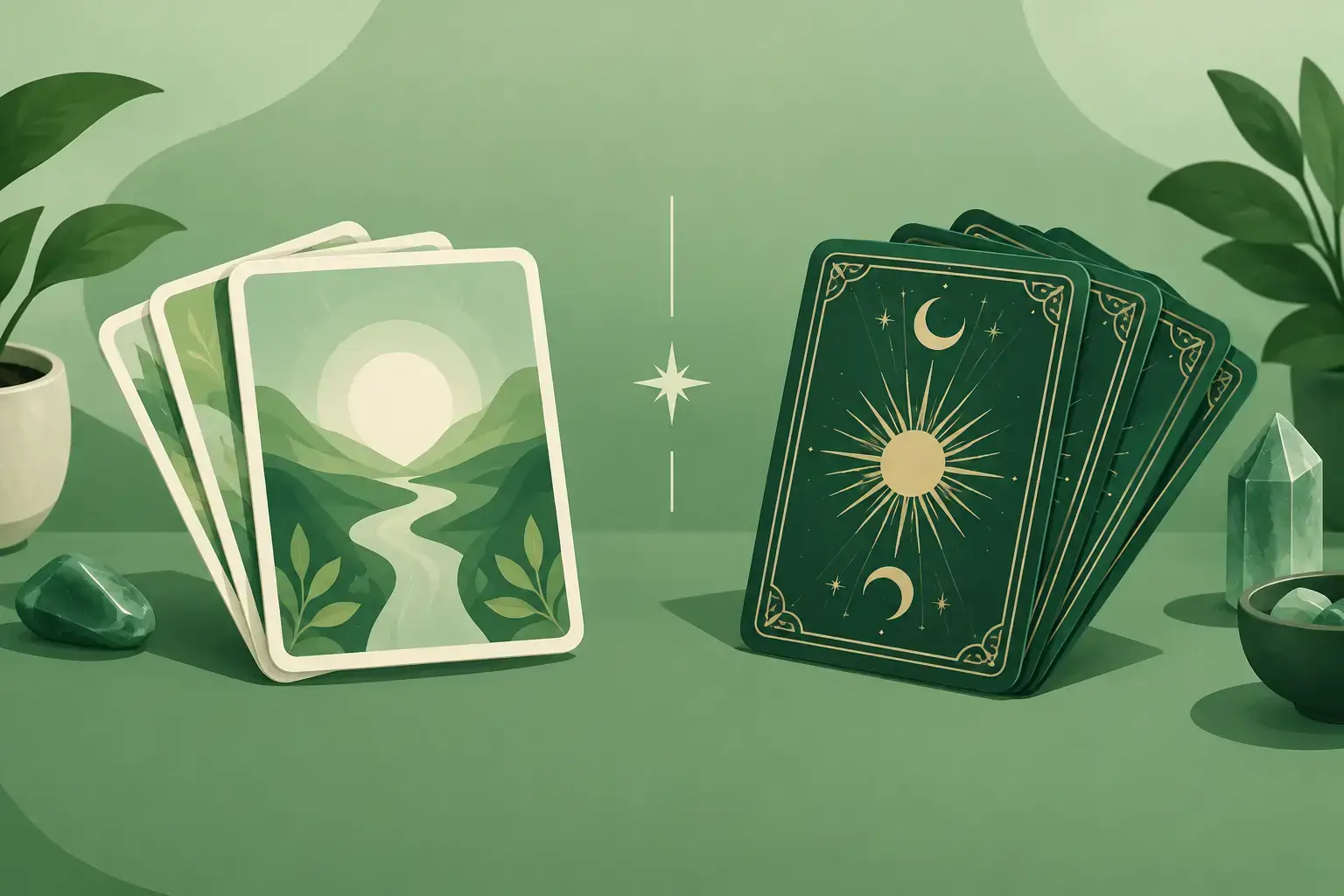
You pick up a beautiful deck, shuffle it, and then freeze. Are you supposed to know 78 card meanings? Can you read the guidebook? What if the image means something different to you? The oracle cards vs tarot cards question matters because the deck you choose shapes how you learn to trust your intuition. Neither is more spiritual, more accurate, or more legitimate. They simply give you different structures for receiving insight.
For beginners, the best deck is rarely the one with the most impressive artwork or the longest list of meanings. It is the one you can return to consistently, with clarity and confidence. Understanding the difference helps you choose a practice that feels supportive now while leaving room for your skills to grow.
Oracle Cards vs Tarot Cards: The Core Difference
Tarot is a defined symbolic system. A traditional tarot deck has 78 cards divided into the 22 Major Arcana and 56 Minor Arcana. The Major Arcana speaks to significant life themes and turning points, while the Minor Arcana explores daily experiences through four suits: Cups, Wands, Swords, and Pentacles. Each suit has numbered cards and court cards, creating a framework you can study step-by-step.
Oracle cards do not follow one universal structure. One oracle deck may have 44 cards, another may have 52, and another may have a completely different number. The creator determines the themes, card names, artwork, and messages. A deck may focus on spirit animals, lunar cycles, affirmations, ancestors, crystals, shadow work, or any other spiritual lens.
That freedom is the greatest strength of oracle cards, but it also explains why they can feel less consistent from deck to deck. Once you learn tarot, the foundations transfer to most traditional tarot decks. Once you learn one oracle deck, you are learning that deck’s specific language.
Tarot Gives You a Map
Tarot is ideal for people who want a system they can build on over time. Its repeated patterns teach you how energy moves through a situation. The Ace of Cups, for example, often points toward an emotional beginning, openness, or a new relationship with feeling. The Ten of Cups expands that suit’s emotional story toward fulfillment, belonging, or shared joy. You are not memorizing disconnected definitions. You are learning a visual and numerical language.
This structure makes tarot especially useful when a question has layers. A tarot spread can explore what is happening, what is influencing it, what needs attention, and what action is available. It gives the reader multiple points of connection, which can make readings more precise.
The trade-off is that tarot asks for patience. You do not need to memorize every meaning before you begin reading, but you do need to spend time with the cards. Reversals, elemental correspondences, numerology, court cards, and spread positions can add useful depth, yet they can overwhelm a beginner when introduced all at once.
A grounded tarot practice starts simple. Learn the Major Arcana first, then the suits, then the numbers. Pull one card a day and write down what you notice before reaching for a guidebook. This is how you develop knowledge without silencing your intuitive response.
Tarot Is Not a Script
A common mistake is treating tarot card meanings as fixed predictions. They are not. The cards offer symbols, themes, patterns, and possibilities. The Five of Pentacles can speak of material strain, exclusion, a scarcity mindset, or the need to accept available support. The right interpretation comes from the question, the surrounding cards, the image, and your intuitive awareness.
Study gives you a reliable foundation. Intuition tells you how that foundation applies to the person and moment in front of you. Both matter.
Oracle Cards Offer a Direct Entry Point
Oracle cards are often easier to approach because the message may be printed directly on the card or explained clearly in the accompanying guidebook. A card titled “Trust the Process” does not require the same level of symbolic decoding as a tarot card such as The High Priestess. For someone who feels nervous about getting a reading wrong, that directness can be reassuring.
Oracle decks are also excellent for daily guidance, journaling, intention setting, and emotional check-ins. You might ask, “What energy would support me today?” and pull a card that prompts reflection without needing a complex spread. This can create a meaningful ritual in just a few minutes.
However, simple does not mean shallow. A well-designed oracle deck can bring forward powerful insight, particularly when its theme matches your current path. An ancestor-focused deck may support lineage work. A moon deck may help you work with cycles, rest, and intention. An affirmation deck can offer encouragement when your nervous system needs gentleness rather than intense analysis.
The trade-off is specificity. Because every oracle deck uses its own system, some decks may feel vague, overly positive, or difficult to apply to practical questions. If every card offers a broad affirmation, it may not give enough detail for a complicated career decision or relationship pattern. That does not mean the deck is ineffective. It means you may need to ask clearer questions, pull supporting cards, or use tarot alongside it.
Which Deck Should You Start With?
Start with oracle cards if you want a low-pressure, intuitive practice and are drawn to a particular theme. They are a strong choice if you want to create a daily ritual, build comfort with receiving messages, or begin exploring your spiritual path without first learning a larger symbolic system.
Start with tarot if you enjoy learning frameworks, want detailed readings, or feel called to develop a skill you can use for yourself and eventually for others. Tarot can initially feel more demanding, but its structure becomes an advantage. You always have a map to return to when your confidence wobbles.
You do not have to make a permanent choice. Many experienced readers use both. Tarot can reveal the situation’s deeper dynamics, while an oracle card can offer a practical focus, a healing message, or a next step. For example, a tarot reading may show you that fear of conflict is blocking clear communication. An oracle card may invite you to speak honestly, protect your energy, or take a pause before responding.
The key is not to use more cards just to make a reading feel more mystical. Use the deck that serves the question. If you need nuanced insight into a decision, tarot may be the better tool. If you need encouragement, perspective, or a gentle prompt for the day, oracle may be exactly right.
How to Read Without Handing Away Your Power
Both tarot and oracle cards work best as tools for reflection and intuitive development, not as authorities that control your choices. A reading can reveal patterns you have overlooked and help you name what you already sense. It should not replace your judgment, professional support, or responsibility for your decisions.
Ask questions that invite agency. Instead of asking, “Will I get the job?” try, “What can I do to show up well in this opportunity?” Instead of, “Does this person love me?” ask, “What do I need to understand about this relationship?” These questions produce readings that are more useful, honest, and empowering.
Keep a journal beside your deck. Record the date, your question, the cards, your immediate impressions, and what unfolds afterward. This practice turns random pulls into real learning. Over time, you will see how certain symbols speak to you personally, where your intuition is accurate, and where fear may be coloring your interpretation.
If you want to read professionally one day, this grounding is essential. Clients need clear, compassionate insight, not dramatic certainty. Structured training helps you understand card meanings, ethical boundaries, question framing, and how to communicate a reading responsibly. At School of Holistic Mastery, that kind of step-by-step learning is designed to help students build usable skills rather than depend on guesswork.
Let Your Practice Be Allowed to Grow
You may begin with an oracle deck because its messages feel welcoming, then find yourself fascinated by tarot’s rich symbolism months later. Or you may study tarot seriously and keep an oracle deck nearby for moments when you need a softer voice. There is no spiritual prize for choosing the harder tool or the trendier one.
Choose the deck that makes you want to sit down, shuffle, listen, and return tomorrow. Consistent practice is where intuition becomes clear, grounded, and genuinely useful.