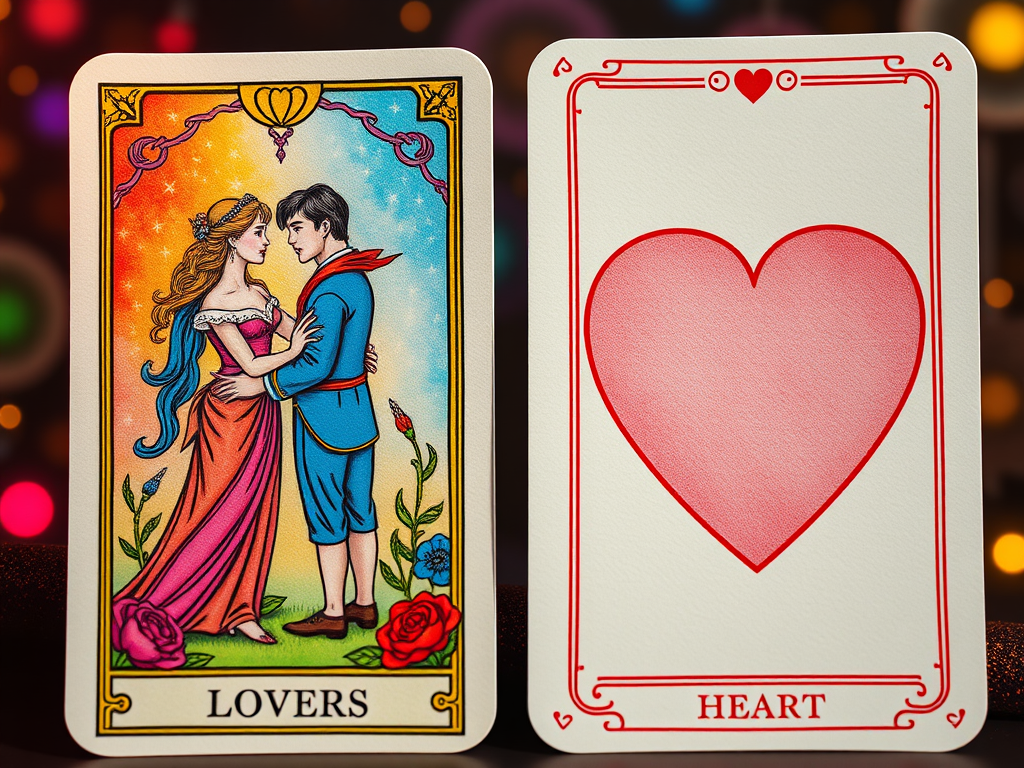
If you’ve spent any time exploring divination, you’ve likely encountered both Tarot and Lenormand. At first glance, they might seem interchangeable — both use cards, both offer guidance, both have devoted followings. But the moment you sit down to actually read with them, the differences become strikingly clear.
Understanding these differences isn’t just academic. It determines which system will feel natural to you, which will answer your questions more effectively, and how you’ll approach readings in your practice.
The Core Philosophy: Poetry vs. Prose
The most fundamental difference between Tarot and Lenormand isn’t about the number of cards or the imagery — it’s about how each system approaches the act of divination itself.
Tarot speaks in archetypes and spiritual symbolism. When you pull The Tower, you’re not just seeing a building struck by lightning — you’re encountering a universal symbol of sudden upheaval, ego death, and divine intervention. The card invites interpretation, contemplation, and personal reflection. It asks: What tower in your life needs to fall? What false structures are you clinging to?
Lenormand, by contrast, deals in the concrete language of everyday life. When you pull the Tower in Lenormand (card 19), you’re looking at an actual institution — a workplace, a government building, a hospital, or a corporation. The card doesn’t ask philosophical questions. It states facts: This situation involves a large organization. There’s formality here. You may feel isolated.
Think of it this way: Tarot is poetry, rich with metaphor and open to interpretation. Lenormand is prose — direct, specific, and grounded in the practical world.
Want to learn more with clarity and guidance?

We offer structured, step-by-step online courses that teach how to become a Lenormand card reader in a grounded, approachable way — so you can actually understand it, practice with confidence, and build real skill over time.
$24 one-time payment · Lifetime access · IPHM-accredited certificate
Many students begin exactly where you are now — curious, drawn to this topic, but unsure how to learn it properly without overwhelm or confusion.
Deck Structure at a Glance
| Aspect | Tarot | Lenormand |
|---|---|---|
| Total Cards | 78 | 36 |
| Card Categories | Major Arcana (22) + Minor Arcana (56) | Single unified system |
| Suits | 4 suits (Cups, Pentacles, Swords, Wands) | No suits (playing card associations exist but are secondary) |
| Court Cards | Yes (Page, Knight, Queen, King) | No (Man and Woman cards serve as significators) |
| Imagery Style | Complex, layered symbolism | Simple, single-image clarity |
| Reversals | Yes (in most traditions) | No |
How Readings Actually Work: A Side-by-Side Example
Let’s say you’re asking about a new job opportunity. Here’s how each system would approach it:
A Tarot Reading
You pull three cards: Seven of Pentacles, The Chariot, Three of Cups.
The Seven of Pentacles suggests you’ve been working hard and waiting for results. The Chariot indicates forward movement and determination — you have the willpower to succeed. The Three of Cups points to celebration and positive collaboration with your new team.
The reading is interpretive. It explores your internal state, your potential, and the energy surrounding the situation. It’s about the journey and what you’ll learn along the way.
A Lenormand Reading
You pull three cards: Fox + Ship + Sun.
Fox (work) + Ship (distance/travel) + Sun (success) reads like a sentence: “Work involving travel leads to success” or “A job opportunity from far away will be very positive.”
The reading is direct. It tells you what will happen in concrete terms. There’s less room for interpretation and more emphasis on the literal outcome.
This difference in reading style is what makes each system suited to different types of questions.

Card Combinations
One of the most significant differences between the two systems is how cards interact with each other.
In Tarot, each card carries substantial meaning on its own. When you lay out a spread, you’re typically reading each card individually within its position, then synthesizing the overall message. A single card can answer a question. The Ten of Cups alone tells you about emotional fulfillment and family harmony.
Lenormand cards, however, rarely stand alone. They function like words in a sentence — individually, they’re just vocabulary, but together they create meaning. The Dog card by itself just means “loyalty” or “friendship,” but combine it with other cards and watch the meaning shift:
- Dog + Ring = A loyal commitment, a faithful partnership
- Dog + Fox = A work colleague, or someone whose loyalty should be questioned
- Dog + Coffin = The end of a friendship, or a sick pet
- Dog + Clouds = Confusion about a friend’s intentions
This combinatorial grammar is what makes Lenormand both logical and endlessly nuanced. You’re not interpreting symbols — you’re constructing sentences.
Timeframes and Prediction Styles
Tarot tends to work with longer arcs of time and emphasizes personal agency. A Tarot reading might show you the path ahead, but it also reminds you that your choices shape the outcome. The cards reveal potentials and possibilities, not fixed destinies. This makes Tarot excellent for questions about personal growth, psychological patterns, and spiritual development.
Lenormand operates on shorter timeframes and tends toward more deterministic predictions. It’s not uncommon for a Lenormand reader to pinpoint specific events or timelines with surprising accuracy. The system excels at answering practical questions: Will I get the job? When will I hear back? Is this person trustworthy?
This doesn’t mean Lenormand is fatalistic or that Tarot can’t make predictions — but each system has its natural strengths.
Learning Curve: What to Expect
Many people assume Lenormand is “easier” because it has fewer cards. And yes, memorizing 36 card meanings is less daunting than memorizing 78. But that’s only the beginning.
Tarot’s learning curve is front-loaded. You spend significant time learning the symbolism, the suits, the court cards, and the Major Arcana journey. But once you understand the cards individually, you can start reading. Your intuition fills in the gaps, and the imagery itself often guides you.
Lenormand’s learning curve is back-loaded. The individual card meanings are simple and quick to learn. But mastering the combinations — understanding how cards modify each other, learning to read lines and houses in the Grand Tableau, developing the skill to weave multiple cards into coherent narratives — that takes real practice and dedication.
Think of it like learning a language. Tarot is like learning vocabulary and letting context guide you. Lenormand is like learning grammar — you need to understand the structure before the sentences make sense.

When to Use Which System
After working with both systems, many readers develop preferences based on the type of question being asked.
Reach for Tarot when:
- You’re exploring psychological or spiritual questions
- You want to understand the deeper “why” behind a situation
- You’re seeking guidance on personal growth or shadow work
- The question is open-ended or philosophical
- You want to explore multiple potential outcomes
Reach for Lenormand when:
- You need a clear, practical answer to a specific question
- You’re asking about timing or concrete events
- You want to know “what” will happen, not just “why”
- You’re reading about everyday matters (work, money, relationships)
- You need straightforward guidance without layers of interpretation
Some readers use both in tandem — Lenormand to answer the “what” and Tarot to explore the “why.”
The Cultural Context
It’s worth noting that Tarot and Lenormand also come from different cultural traditions, which influences how they’re used today.
Tarot has deep roots in Western esoteric traditions. It’s been connected to Kabbalah, astrology, and ceremonial magic. This gives it a spiritual gravitas and makes it particularly well-suited to inner work and mystical exploration.
Lenormand emerged from European parlor games and fortune-telling salons. It was designed to be practical, accessible, and focused on the concerns of daily life — love, money, health, and social standing. This heritage shows in its straightforward, no-nonsense approach.
Neither tradition is better or more valid. They simply serve different purposes and appeal to different sensibilities.
Finding Your Path
If you’re trying to decide which system to learn first, consider what draws you to divination in the first place.
Are you fascinated by symbolism, mythology, and the inner landscape of the psyche? Do you love the idea of archetypal journeys and spiritual transformation? Tarot will likely resonate with you.
Are you more interested in practical guidance and concrete answers? Do you appreciate logic, structure, and systems that follow clear rules? Lenormand might be your natural fit.
And if you’re not sure? Try both. Pull a daily Tarot card and a daily Lenormand pair for a month. See which system speaks to you more clearly, which readings prove more accurate, and which practice you look forward to each day.
Many of the most skilled readers eventually learn both systems — not because one is incomplete without the other, but because each offers a unique lens through which to view life’s questions.
Final Thoughts
Lenormand and Tarot are not competitors. They’re complementary tools in the diviner’s toolkit, each with its own strengths, its own voice, and its own way of revealing truth.
Tarot invites you into the depths. Lenormand keeps you grounded in the practical. Tarot asks you to reflect. Lenormand tells you what to expect. Tarot is the counselor; Lenormand is the advisor.
The question isn’t which system is better — it’s which one serves your needs in this moment, for this question, in this stage of your practice.

If this topic resonates with you, you don’t have to figure it out alone or piece everything together from scattered resources.
Our accredited online courses guide you through becoming a Lenormand card reader step by step — with clear explanations, practical lessons, and lifetime access so you can learn at your own pace and return whenever you need.
Whether you’re just starting or deepening an existing practice, this is a grounded way to learn with confidence.
$24 one-time payment · Lifetime access · IPHM-accredited certificate
You must be logged in to post a comment.