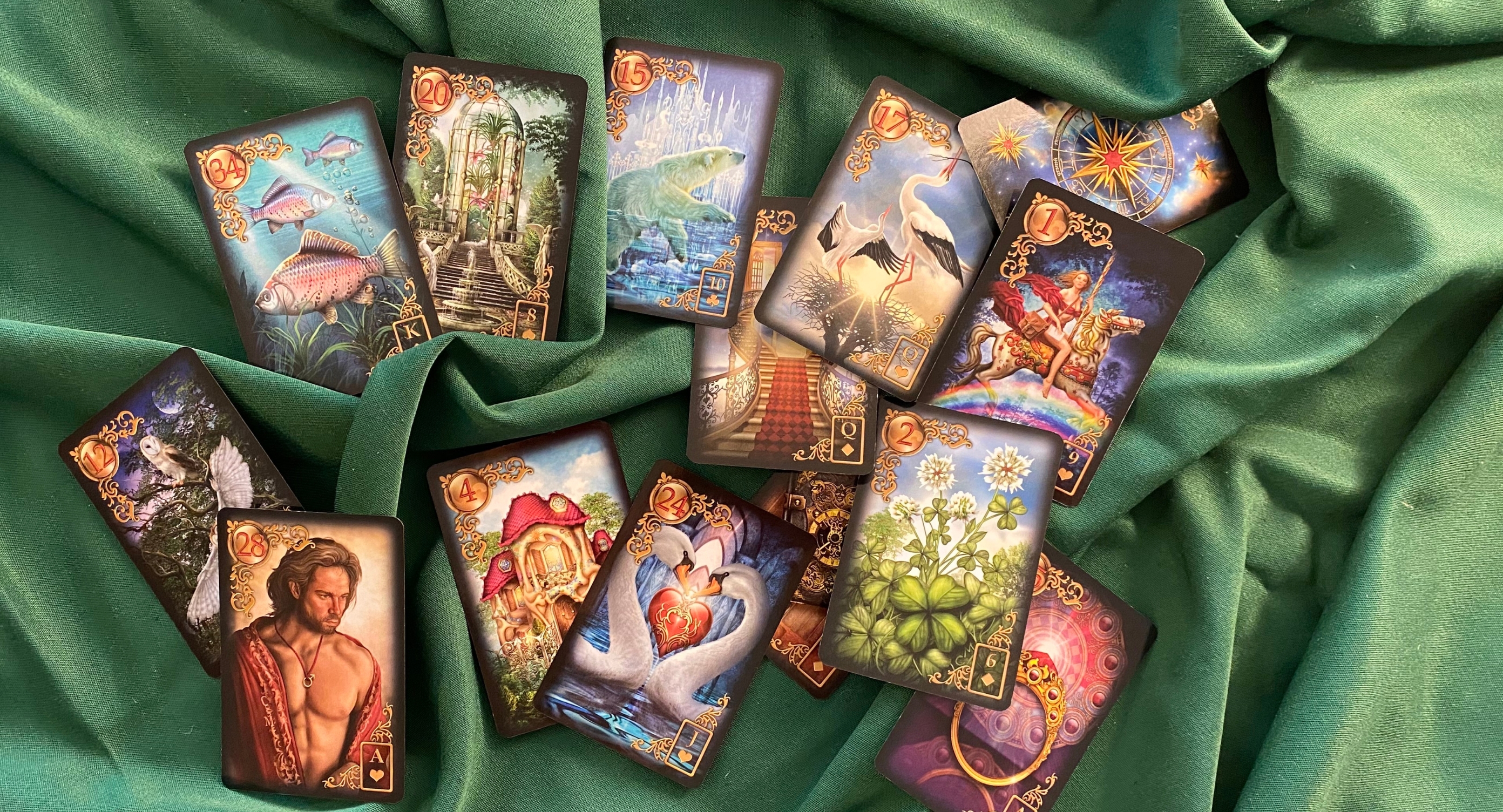
Everything you need to start reading Lenormand cards with confidence — from the history of the deck to all 36 card meanings and your first spread.
What Is Lenormand?
Lenormand is a 36-card oracle system used for divination, self-reflection, and practical guidance. Unlike Tarot, which deals in archetypes and spiritual symbolism, Lenormand speaks in the language of everyday life — a dog, a house, a key, a letter. Its symbols are grounded, direct, and surprisingly powerful.
If you have ever wanted a card system that gives you clear, concrete answers rather than poetic riddles, Lenormand might be exactly what you have been looking for.
The deck is named after Marie Anne Adélaïde Lenormand (1772–1843), a celebrated French cartomancer who read for Napoleon Bonaparte, Empress Joséphine, and Tsar Alexander I. Though the cards bearing her name were published after her death, her legacy gave the system its identity and mystique.
Today, Lenormand is experiencing a global revival. From seasoned Tarot readers looking for a more literal system to complete beginners drawn to its simplicity, more people than ever are picking up a Lenormand deck.
Want to learn more with clarity and guidance?

We offer structured, step-by-step online courses that teach how to become a Lenormand card reader in a grounded, approachable way — so you can actually understand it, practice with confidence, and build real skill over time.
$24 one-time payment · Lifetime access · IPHM-accredited certificate
Many students begin exactly where you are now — curious, drawn to this topic, but unsure how to learn it properly without overwhelm or confusion.
A Brief History of Lenormand Cards
Marie Anne Lenormand was born in Normandy, France, in 1772. Orphaned by age five, she was raised in a Catholic school before making her way to Paris at fourteen. She became one of the most famous fortune-tellers of her era, attracting clients from the highest levels of European society.
After her death in 1843, German publishers began producing cartomancy decks in her name. These were based on an older French card game — the Jeu de la Boîte — and the 36-card format became the standard we use today. The system spread across Europe, with German, French, and other regional schools each developing their own interpretive traditions.
The Petit Lenormand (the 36-card version) is the most widely used format today. A larger version, the Grand Lenormand, exists but is far less common and considerably more complex.

Lenormand vs. Tarot: Key Differences
Many people come to Lenormand through Tarot, and understanding the differences between the two systems is one of the most important first steps.
The most important distinction: Lenormand cards are almost always read in combination. A single card rarely tells the full story. Two or three cards together form a sentence — and that sentence is your answer.
How the Lenormand System Works
Cards Are Read Like a Language
In Lenormand, cards function like words in a sentence. The first card is typically the subject, and the cards that follow modify or describe it.
For example:
- Dog + Ring = A loyal commitment, or a faithful partner
- Ship + Fox = A work trip, or a suspicious journey
- Tree + Stars = Health improving, or spiritual growth
This “sentence grammar” is what makes Lenormand both logical and learnable. Once you know the keywords for each card, you can start building meaning immediately.
No Reversals
Lenormand cards do not have reversed meanings. Instead, each card carries both positive and challenging associations within its upright meaning. Context — and the cards surrounding it — determines which energy is at play.
The Significator Card
Most Lenormand readings use a significator — a card that represents the person being read for. Traditionally, the Man card (28) or Woman card (29) is used. The cards surrounding the significator in a spread reveal what is happening in that person’s life.

Playing Card Associations
Each Lenormand card also corresponds to a playing card. While not essential for beginners, these associations can add nuance to your readings over time. For example, hearts relate to emotions and relationships, clubs to material matters and home life, spades to thoughts and challenges, and diamonds to energy and action.
All 36 Lenormand Card Meanings
Here are the core keywords and meanings for all 36 cards. For each card, focus on learning 3–5 keywords first before expanding your vocabulary.
1. The Rider
Keywords: News, messages, arrivals, speed, movement
The Rider brings something new — usually quickly. It often signals incoming news, a visitor, or fast-moving energy. In practical readings, it can literally mean a delivery, a phone call, or a new development arriving soon.
2. The Clover
Keywords: Luck, opportunity, small blessings, chance
A cheerful card. The Clover represents small but meaningful strokes of good fortune. It suggests that luck is on your side, though usually in modest, everyday ways rather than life-changing windfalls.
3. The Ship
Keywords: Travel, journeys, distance, ambition, enterprise
The Ship speaks of movement — physical travel, long-distance matters, or the pursuit of a goal over time. It can also represent foreign connections, business ventures, or a longing for something beyond the horizon.
4. The House
Keywords: Home, family, stability, property, tradition
The House is grounded and domestic. It represents your home environment, family life, real estate, and the sense of security that comes from having a stable foundation. It can also indicate a long, careful process.
5. The Tree
Keywords: Health, roots, growth, ancestry, the past
The Tree is one of the most important cards in the deck. It primarily relates to health and wellbeing, but also to deep roots — family lineage, long-standing situations, and things that have been growing slowly over time.
6. The Clouds
Keywords: Confusion, uncertainty, obstacles, unclear situations
The Clouds bring fog and doubt. When this card appears, clarity is lacking. Look at the surrounding cards to determine whether the confusion is lifting (bright side of the clouds) or deepening (dark side).
7. The Snake
Keywords: Betrayal, deception, complications, wisdom, a rival
The Snake is a card of caution. It can signal dishonesty, a complicated situation, or a rival. In some traditions it also carries the wisdom of the serpent — diplomacy, strategy, and navigating difficult terrain.
8. The Coffin
Keywords: Endings, transformation, illness, loss, closure
The Coffin marks the end of something. While it can feel ominous, endings are often necessary for new beginnings. It can relate to illness, the conclusion of a chapter, or a significant transformation.
9. The Bouquet
Keywords: Gifts, beauty, appreciation, social grace, happiness
The Bouquet is a warm and welcoming card. It speaks of kindness, compliments, social invitations, and the pleasure of being appreciated. It often softens the cards around it.
10. The Scythe
Keywords: Sudden cuts, decisions, danger, harvest, endings
The Scythe is sharp and swift. It represents sudden events, abrupt endings, or decisive action. It can warn of an accident or unexpected cut — but it also represents the harvest, reaping what you have sown.
11. The Whip
Keywords: Conflict, arguments, repetition, challenge, discipline
The Whip signals friction. It can represent ongoing arguments, recurring problems, or the hard work of discipline and training. In some contexts it speaks of physical activity or sport.
12. The Birds
Keywords: Communication, conversations, anxiety, chatter, phone calls
The Birds are always talking. This card relates to verbal communication, discussions, negotiations, and sometimes nervous energy or worry. It can literally mean a phone call or an important conversation.
13. The Child
Keywords: New beginnings, innocence, something small, a child, naivety
The Child represents something new and untested — a fresh start, a young person, or a situation that is still in its early stages. It brings a sense of innocence and possibility, but also inexperience.
14. The Fox
Keywords: Work, cunning, self-employment, caution, deception
The Fox is clever and watchful. It primarily relates to work and employment, but also to situations where someone (or something) may not be entirely trustworthy. It encourages careful observation.
15. The Bear
Keywords: Power, strength, authority, finances, a boss
The Bear is strong and commanding. It often represents a powerful figure — a boss, a parent, or a financial authority. It can also speak to personal power, physical strength, and large sums of money.
16. The Stars
Keywords: Hope, guidance, clarity, spirituality, wishes
The Stars are one of the most positive cards in the deck. They bring clarity, inspiration, and the sense that things are aligning in your favour. They relate to dreams, spiritual guidance, and the fulfilment of wishes.
17. The Stork
Keywords: Change, transformation, pregnancy, new cycles, movement
The Stork announces change — often a welcome one. It can relate to a house move, a new phase of life, pregnancy, or any significant shift in circumstances. It brings restless, forward-moving energy.
18. The Dog
Keywords: Loyalty, friendship, trust, a friend, support
The Dog is one of the most straightforward cards in the deck. It represents loyal friends, trusted companions, and supportive relationships. It can also literally indicate a pet or an animal lover.
19. The Tower
Keywords: Authority, institutions, isolation, the past, corporations
The Tower represents large structures — both physical and institutional. It can mean a government body, a corporation, a hospital, or a school. It also speaks of solitude, formality, and long-established systems.
20. The Garden
Keywords: Social life, community, public spaces, events, groups
The Garden is where people gather. It represents social events, public life, communities, and networks. It can indicate a party, a public announcement, or your wider social circle.
21. The Mountain
Keywords: Obstacles, delays, challenges, blockages, slow progress
The Mountain stands in the way. It represents significant obstacles, long delays, and situations that require patience and persistence to overcome. Progress is possible — but it will be slow.
22. The Crossroads
Keywords: Choices, decisions, alternatives, freedom, paths
The Crossroads presents options. It signals a decision point, a fork in the road, or the freedom to choose your own direction. It encourages you to weigh your options carefully before committing.
23. The Mice
Keywords: Loss, stress, deterioration, theft, anxiety
The Mice gnaw away at things. This card signals gradual loss, stress, or something being slowly eroded — whether that is money, health, confidence, or a relationship. It encourages you to address problems before they worsen.
24. The Heart
Keywords: Love, romance, emotions, kindness, passion
The Heart is the card of love in all its forms — romantic love, compassion, generosity, and emotional warmth. It is one of the most positive cards in the deck when it comes to matters of the heart.
25. The Ring
Keywords: Commitment, contracts, cycles, partnerships, promises
The Ring represents binding agreements — a marriage, a contract, a business partnership, or any formal commitment. It also speaks of cycles and things that come full circle.
26. The Book
Keywords: Secrets, knowledge, education, the unknown, research
The Book holds information — sometimes hidden, sometimes revealed. It can represent formal education, research, a secret being kept, or knowledge that is yet to be uncovered.
27. The Letter
Keywords: Written communication, documents, emails, news in writing
The Letter is all about written words. It can represent an email, a contract, a legal document, a text message, or any form of written communication. News is coming — in written form.
28. The Man
Keywords: A male-identifying person, the querent (if male)
The Man card is primarily a significator card representing a male-identifying person in the reading. The cards surrounding it describe that person’s situation, character, or role in the querent’s life.
29. The Woman
Keywords: A female-identifying person, the querent (if female)
Like the Man card, the Woman is a significator. The surrounding cards describe her situation, personality, or influence in the reading.
30. The Lily
Keywords: Peace, maturity, sensuality, wisdom, winter, older figures
The Lily brings calm and refinement. It represents peace, moral integrity, and the wisdom that comes with age. It can also relate to sensuality, an older person, or the winter season.
31. The Sun
Keywords: Success, vitality, joy, clarity, victory, abundance
The Sun is one of the most positive cards in the entire deck. It brings warmth, success, and radiant energy to everything it touches. When the Sun appears, things are going well — or they are about to.
32. The Moon
Keywords: Emotions, intuition, recognition, fame, the subconscious
The Moon illuminates the inner world. It relates to emotions, intuition, creative recognition, and sometimes public fame or reputation. It can also speak to cycles, dreams, and the unconscious mind.
33. The Key
Keywords: Solutions, success, certainty, unlocking, destiny
The Key opens doors. It is a highly positive card that signals resolution, certainty, and the unlocking of potential. When the Key appears near another card, it confirms that situation as important or resolved.
34. The Fish
Keywords: Money, finances, abundance, flow, independence
The Fish swim in the waters of abundance. This card primarily relates to financial matters — cash flow, business, investments, and material resources. It can also speak to emotional depth and independence.
35. The Anchor
Keywords: Stability, perseverance, work, security, long-term goals
The Anchor holds firm. It represents steadiness, hard work, and the security that comes from commitment and persistence. It often relates to long-term employment or a stable, enduring situation.
36. The Cross
Keywords: Burden, fate, spirituality, suffering, destiny
The Cross is one of the more challenging cards in the deck. It speaks of burdens, unavoidable trials, and the weight of fate. It can also carry a spiritual dimension — the acceptance of what cannot be changed, and the courage to carry on.
How to Read Lenormand Cards
Step 1: Start With Pairs
The best way to begin reading Lenormand is to pull two cards and form a sentence. The first card is the subject; the second modifies or describes it.
- Heart + Key = Love is certain / A key relationship
- Fox + Book = Work secrets / A cunning researcher
- Clouds + Sun = Confusion clearing / Uncertainty giving way to success
Practice pulling pairs daily. It builds your vocabulary faster than any other method.
Step 2: Move to Three-Card Lines
A three-card line gives you a subject, a context, and an outcome — or a beginning, middle, and end. Read them left to right as a flowing sentence.
Example: Rider + Heart + Ring
“News about love leads to a commitment.”
Step 3: Use a Significator
Once you are comfortable with pairs and triplets, try placing your significator card (Man or Woman) in the centre of a small spread. The cards to the left represent the past or what is leaving; the cards to the right represent the future or what is coming.
Step 4: Work Toward the Grand Tableau
The Grand Tableau is the signature spread of Lenormand — all 36 cards laid out in a grid, offering a complete map of a person’s life. It covers love, work, health, finances, and more simultaneously.
It can feel overwhelming at first. The best approach is to flip the cards face down and reveal one section at a time, reading each section as a smaller spread before stepping back to see the whole picture.
Lenormand Spreads for Beginners

The 2-Card Draw (Daily Practice)
Pull two cards each morning as a reflection on the day ahead. Simple, fast, and incredibly effective for building your reading skills.
The 3-Card Line (Situation–Action–Outcome)
A classic spread for specific questions. Lay three cards in a row and read them as a sentence: what is happening, what action is needed, and what the likely outcome is.
The 5-Card Cross (Overview Spread)
Place one card in the centre and one in each direction (above, below, left, right). The centre card is the core theme; the surrounding cards offer context from different angles — past, future, advice, and hidden influences.
The 9-Card Square (Detailed Reading)
Lay nine cards in a 3×3 grid. The centre card is the focus; the surrounding eight cards provide detail. Read the rows and columns as sentences for a rich, layered reading.
The Grand Tableau (Full Life Reading)
All 36 cards laid out in rows. Traditionally arranged as four rows of eight cards plus a final row of four, or as a 6×6 grid. This is the most powerful Lenormand spread and the one most readers aspire to master.
Beginner Tips & Common Mistakes
Do start with keywords, not long descriptions. Learn 3–5 keywords per card before diving into nuanced meanings. Keywords are the building blocks of every reading.
Do read cards in combination. A single Lenormand card rarely gives you the full picture. Always look at what surrounds it.
Don’t worry about reversals. There are none in Lenormand. The positive or challenging energy of a card is determined by context, not orientation.
Do assign personal meanings to cards. The Tower might mean your workplace. The Bear might mean your mother. Personalising the cards makes your readings far more accurate.
Don’t rush to the Grand Tableau. Master pairs and triplets first. The Grand Tableau will make much more sense once you have a solid foundation.
Do practice daily. Even a two-card pull each morning will build your skills faster than occasional long sessions.
Don’t be afraid of “negative” cards. The Coffin, the Mice, the Cross — these cards are not omens of doom. They are information. They tell you where challenges lie so you can address them.
Do trust your intuition. Lenormand is a system, but it is not a machine. Your instincts matter. If a combination sparks a strong feeling, follow it.
FAQ
Is Lenormand easier to learn than Tarot?
In some ways, yes. With only 36 cards and no reversals, the initial learning curve is gentler. However, mastering card combinations and the Grand Tableau takes real dedication. Think of it as easier to start, but just as deep to master.
Do I need to be psychic to read Lenormand?
Not at all. Lenormand is a learnable skill. The system is logical and language-based, which means anyone willing to study the card meanings and practice combinations can become a capable reader.
Can I use any Lenormand deck?
Yes. While the imagery varies between decks, the 36-card system and core meanings remain consistent. For beginners, a deck with clear, traditional imagery is recommended — it makes learning the symbols much easier.
How is Lenormand different from oracle cards?
Oracle cards have no fixed system — each deck creates its own rules and meanings. Lenormand is a structured system with consistent card meanings, a grammar for combining cards, and established spreads. It sits between oracle cards and Tarot in terms of structure.
What is the best first spread for a complete beginner?
Start with a simple two-card daily draw. Pull two cards each morning, form a sentence, and see how it plays out during the day. This is the fastest way to build confidence and intuition simultaneously.
Final Thoughts
Lenormand is one of the most practical and grounded divination systems available. Its power lies not in mystery or complexity, but in clarity — the ability to take the symbols of everyday life and weave them into meaningful, actionable guidance.
Start small. Learn your keywords. Pull pairs every day. And trust that with time and practice, the cards will begin to speak to you in a language that feels entirely natural.
The 36 cards of the Petit Lenormand have been guiding people for over two centuries. Now it is your turn.

If this topic resonates with you, you don’t have to figure it out alone or piece everything together from scattered resources.
Our accredited online courses guide you through becoming a Lenormand card reader step by step — with clear explanations, practical lessons, and lifetime access so you can learn at your own pace and return whenever you need.
Whether you’re just starting or deepening an existing practice, this is a grounded way to learn with confidence.
$24 one-time payment · Lifetime access · IPHM-accredited certificate
You must be logged in to post a comment.